A Design Genealogy in Ten Lessons
Approximately ten thousand years ago in August, I submitted a ballot for something called the Polaris List. Polaris is a non-profit that runs a yearly retreat (Featuring a sort of "unconference") for game designers. This year, they solicited professional game designers to list the ten games that most influenced them. They got 167 responses, of which one is mine.
Polaris emphasizes that this isn't supposed to be a "best games" list; it's a list of games that influenced or inspired those designers. The collated list can be seen here, and includes contributions from folks like Brenda Romero, Brendon Chung, Emily Short, Lucas Pope, Tarn Adams, and others.
I was really interested to see the final tally, and in how well (or not) my own ballot tracked the overall averages. So: here's the ballot I submitted, in order of where those games placed in the overall ranking, and my own thoughts on why I picked it and what I got from it.
#3: Dwarf Fortress
It's simultaneously a bit wild and unsurprising to see Dwarf Fortress, a beloved but still relatively niche indie game, listed here just after cultural phenomena like Sid Meier's original Civilization and Portal. Dwarf Fortress' approach to procedural generation is vital. One major aspect of this is that Dwarf Fortress doesn't just generate a world, but a whole cosmology and theodicy. Different worlds have different pantheons of gods that represent different concepts. They have different species of monsters that can spawn in them. The game engages in a sort of meta-procedural generation, where it's not just generating "content" but the parameters of that content.
Beyond its influence on procgen in general, DF also stands as a sort of philosophical beacon. It has been described as coming from an alternate universe of video games; one where video games directed the ever-increasing capabilities of computers not towards ever more graphical fidelity but towards ever more density and complexity of systems.
#22: Sid Meier's Pirates!
A number of games rank higher on this list than they ever would on a typical best-games-of-all-time list, or in general video game audience consciousness: Star Control, M.U.L.E., and of course, Pirates!
I've written previously about the role of theme in game design, and this game remains the gold standard of building a game purely to further these thematic ambitions. Everything in Pirates! is in it because it furthers those thematic ideas; nothing is in it that doesn't. Take the game's combat system, such as it is; it's designed explicitly and obviously to try and capture a highly choreographed Errol Flynn swordfight, in which dozens of blade clashes culminate with one combatant being disarmed or nicked in the shoulder.
It has nothing to do with hit points or damage numbers or any other typical game combat system tropes. It exists only for duels that are about one specific outcome in the context of a broader narrative. When you board a ship, you duel that ship's captain and that's all the swordplay that you get, because that's all the swordplay that's thematically necessary. A modern game would want to pay off having sword combat in it by making you engage in rather a lot of it, having proper "combat sections", giving you disposable enemies to cut down.
Pirates is, then, notable in both its parsimony and its generosity. It gives you so much – there's both naval and land battles, there's sacking cities and digging for hidden treasure, there's trade winds and bounties, there's the politics of the Caribbean and bodice-ripper romance. But it gives you just enough of each one of those things, no more no less, to achieve its thematic aims.
#33: The Legend of Zelda: A Link to the Past
Breath of the Wild came in much higher, and that game certainly has had an outsize influence on the design of open-world games ever since it came out. But A Link to the Past is effectively my childhood Zelda, which makes me my earliest memory of a game that had mysteries, secrets, and a sense of open-ended exploration. A Link to the Past's Dark World is certainly one of the Great Ideas in video games, an incredible example of a sequel being built on one brilliant mechanical twist on the original game.
For me, Link to the Past is the archetypal Zelda game, the ur-zelda, and therefore a touchstone for so much of adventure, role-playing, and exploration game design. Unlike the original Legend of Zelda, it includes a lot of the affordances that would make these kinds of games digestible for a mass audience: there's a proper in-game map; there's objective markers; there's an inventory screen that implies what you're missing, and so on. So much of our shared UX vocabulary was popularized by this game. But so many other things, too. This game is a little crash course on how to hide things in game spaces. On how to tightly integrate game spaces to game mechanics and make them sing together; this is the game that really solidifies the classically Zelda idea that each dungeon is essentially an essay on the item that you find in that dungeon.
#52: Return of the Obra Dinn
I made an actual Obra Dinn-like (KINOPHOBIA) last year, so how can I not? Return of the Obra Dinn is a fantastic game for its storytelling and how it pursues that storytelling. For its striking, stark presentation that looks and sounds like nothing else.
But most of all, it's a game that solves a very difficult design problem with what feels ultimately like nothing but elegance and grace: How to engage the player in a mystery, and make their play conjoined to their engagement in that mystery. Mystery games have always been hard to design, often producing games that rely on trial and error or are more about the trappings of mystery solving than the actual process of gathering evidence and making deductions. Obra Dinn is the most recent game on my list, yet it already feels like a huge turning point in the history of mystery, deduction, and investigation games.
Most of all, this is a game fundamentally about what's going on in the player's head and the mental model they are assembling as they play; it's a game that showed me that a knowledge game can be at once rigorous and graceful.
#84: Fallen London
Okay, okay, okay. It is perhaps gauche to list a game I worked on myself, but hear me out here. This is a list of games that influenced me, not a list of games I personally like or think are great or want to promote. And Fallen London was hugely influential on me before I worked on it. I made and released a whole game (Voyageur) that uses the storylet narrative structure of Fallen London as one of its structural pillars.
Fallen London is ultimately an achievement in bringing writing and design together through extremely thoughtful choices on both ends; it is for my money one of the major milestones in the history of narrative design. On the Polaris list, it's very funnily sandwiched between Portal 2, the sequel to the actual most influential game on the list, and Team Fortress 2, a genre-defining title that was massively popular.
Fallen London's genius is in looking at the structure that a storylet narrative implies – a diffuse "soup" of atomic chunks of story, built to be experienced out of order and in short bursts – and defining not only a story that suits this format but a whole way of writing that suits this format. I should know, I wrote documentation meant to help people learn how to write like that. It'd be kind of absurd for me, someone who made a career out of being an expert in storylet narrative, to not list the ur-storylet narrative as an influence.
Beyond this, though, FL is full of interesting revelations. It's one of the narrative games that is most comprehensive about really using the whole game to tell its story. Every piece of text in the game furthers the story; not just the main body text, but the little messages you get when your stats change, the tooltips that describe items, the ever-present sidebar full of cryptic writing, even the text at the very start asking you to pick your character's gender.
#87: Crusader Kings 2
Narrative designers are all a little insane for soap opera generators, and this is the one I am personally insane for. Crusader Kings 2 exemplifies how you can take a genre not normally associated with dense narrative and just drench it in brilliant systemic narrative, injecting personality into player narratives at every turn. It's one of the great "and then this happened" games. More than anything it's a lesson in how narrative and systems design interact and intersect. You need chaos so that the system can surprise, but you also need legible chains of cause and effect. You need systems that are transparent enough that the player can peer into them and understand what's going on, but ambiguous enough to leave room for their interpretation.
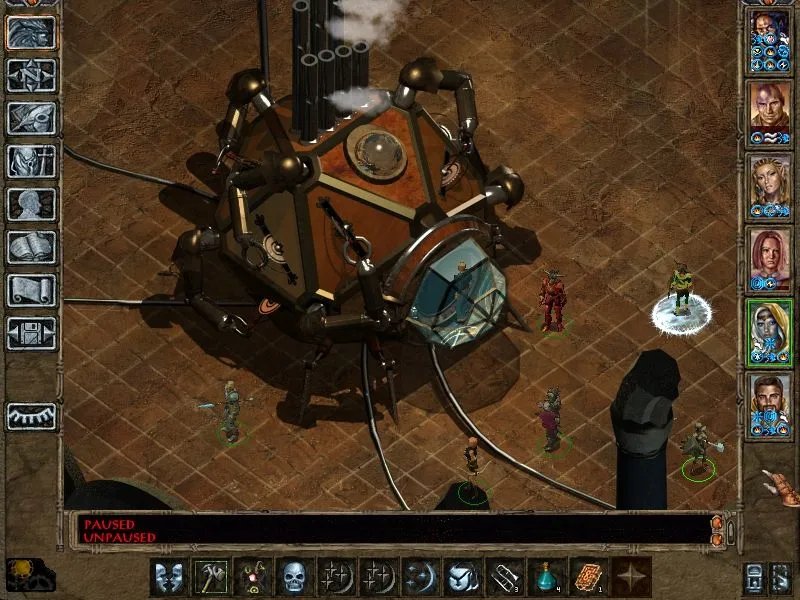
Baldur's Gate 2
I'm surprised that none of the Infinity Engine games are on the final list! Baldur's Gate 2 is so profoundly responsible for the voice of RPG companions and NPCs in general in story-heavy games; it's just revelatory in how it brings these characters to life to such a degree. That's really what separates it from the first game; it really views the companion characters as characters with arcs and deep-set personalities, rather than game pieces. I think a lot of people had a similar revelation from Final Fantasy VII, but I simply never owned a PSX.
The other thing about these old Infinity Engine games that inspires me is just their incredible sense of possibility and scope. The vast pre-rendered 3D environments these games take place in are simply unlike anything else that existed at the time; they're these vast dioramas of a world built in what seems like impossibly intricate detail, bursting with character and history. I don't think any game felt as big to me as Baldur's Gate 2 until many years later.
Spider & Web
In a sense I wrote this into the list as a proxy for parser interactive fiction in general, which is a well I drink from as a sort of collective endeavor. On a different day I might have picked Aisle, A Mind Forever Voyaging, Galatea, Counterfeit Monkey, Bureaucracy, Anchorhead, or Slouching Towards Bedlam. Funnily enough, I never would have picked Zork (a game I never played until much later) or Hitchhiker's Guide to the Galaxy (a game I simply like much less than other Infocom classics).
But more than that, this is in my view a central game in the canon of game stories that play with alignment and misalignment; the boundaries between the player's knowledge, motivation, and actions and the character's knowledge, motivation, and actions. Spider & Web is a game built around gradually bridging that gap, peeling away layers of falsehood to eventually step into the mental framework of the player character. There are other games that play in this space, but Spider & Web is the one that articulated this idea for me – and also it came out in 1998, long before any other example I can think of.
Dungeon Crawl Stone Soup
I suspect many individual lists will have some case of the "hipster's choice", writing in a game that is not named as often as another, quite similar game mostly because this is the one I actually played a lot, and not Nethack.
Ultimately for me this game stands in for everything that traditional roguelikes have given to game design at large, which is a lot – lessons about serendipity, the texture of procedurally-generated levels, the narrowing and broadening of possibilities through the interplay of player choice and random chance. Crawl is also a great example of weaving different scales of authored content together in a procedural system; it contains both procedurally-generated levels and much more hand-authored "vaults", which are joined together in various ways.
Hollow Knight
The thing that I find critically inspiring about Hollow Knight is its gleeful deployment of what I call "wasteful delight". Wasteful delight is when a game includes material that is very missable – hidden from most players, in fact – with the intent of heightening the experience of those players who do find it. Baldur's Gate 3 is another game notoriously full of wasteful delight, with numerous interactions, conversation branches, and events that will not be seen on the majority of playthroughs.
But that game is too recent, and Hollow Knight's particular deployment of this concept is so elegant, thorough, and perfect that for me it's the ur-example. It's the explicit intent of HK's designers to create a sense that a hidden passage could have anything behind it: resources, narrative, new abilities, forbidding bosses, or even a whole area. The game creates this intense sense of connection with the parts of it that you do experience, because you come to appreciate that it was not guaranteed that you would have seen those things. The flip side of that, of course, is that the game is so riddled with secrets and quasi-secrets that you will see some of them. Sometimes the only way to create something magical is to put an unreasonable, seemingly extravagant amount of work into it.