Impressions of the Magic Arena Powered Cube
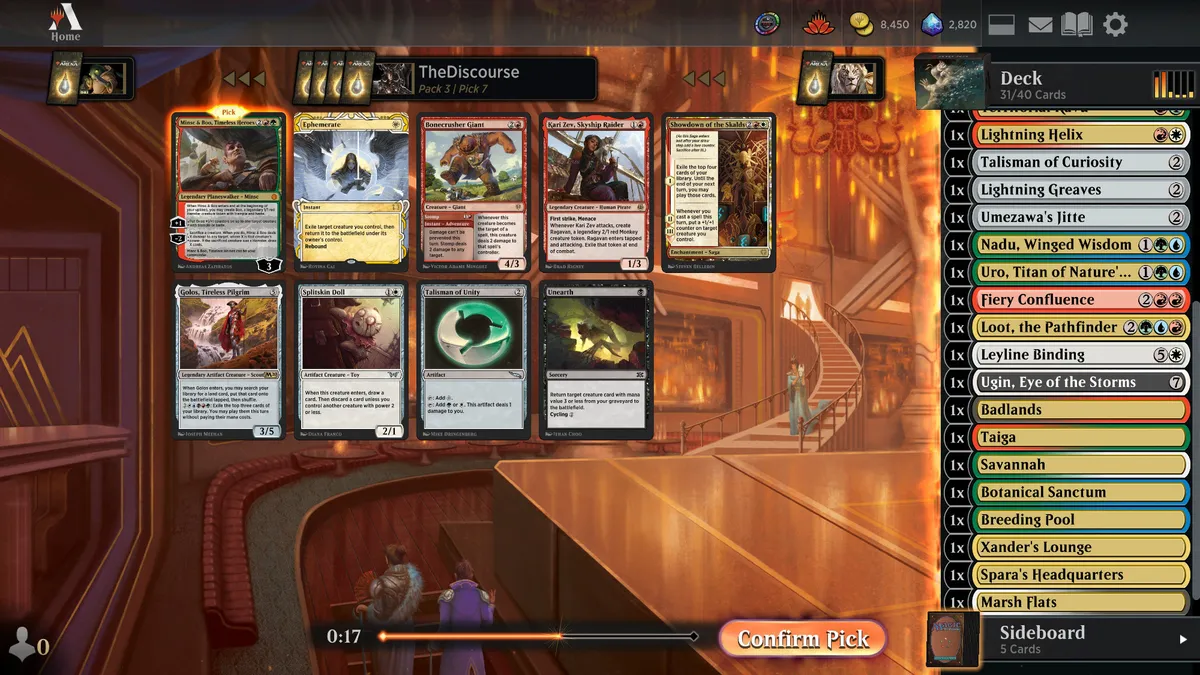
Cube is back on Magic: the Gathering Arena, and so I've been playing a lot of it because this is the very most special form of cube: powered cube.
If you're unfamiliar with cube, a cube is a curated box of cards from throughout Magic's history, which you draft. Often cubes are exactly 360 cards and singleton – exactly enough cards so that a pod of 8 players can draft 3 rounds of 15-card packs, with each card appearing exactly once.
Powered cube means a cube that contains the very most powerful cards in Magic – meaning, typically, the Power Nine plus Sol Ring, Mana Crypt, and several of the most broken cards ever printed. It's the most no-holds-barred, high-powered form of Limited Magic, and it is tremendously fun.
This is the very first time powered cube has been on Arena, including several new and unique cards. This cube is not exactly the same as the Magic: the Gathering Online Vintage Cube, with a somewhat-different card pool that omits various cards that aren't on Arena.
Probably the biggest difference here though is just the difference in player base. Arena has never had powered cube before, and the player base on Arena skews generally younger and less experienced with Magic; consequently, it's been a lot of fun teaching Arena zoomers about Strip Mine lock or about turn 1 Mind Twist.
Hence the screenshot above, showing Minsc & Boo – one of the very best non-Power cards in the cube, a card that almost never should go later than third – being picked seventh.
Powered cube, even when it's somewhat unbalanced or less-than-ideal, is still a blast – there's just so many different things you can be doing, so many different paths during drafting, and so much novelty to the game situations that arise. If normal Magic is eating a delightful pickled jalapeño pepper, powered cube is snorting ground-up ghost peppers. It is Magic for incorrigible sickos.
It's interesting though to observe that this is the first time this style of Magic has been subjected to the glaring light of Magic Arena player data collection. There's a large contingent of Arena players who use third-party software to track all of their plays and results, and this data is voluntarily shared and aggregated on websites like 17land. So for the first time, we have real card winrate data for powered cube, bringing the analytics revolution to one of the last unexplored corners of serious Magic play.
And what does the data tell us? That Ajani, Nacatl Pariah is a messed up card, currently sitting at a 64% game-in-hand winrate, higher than Black Lotus. Before you go picking it first ahead of Power, though, do note that this is a warped statistic.
Here's what's actually going on: Ajani is of course almost always played in white-red aggro decks; these decks are simply very, very successful in the current iteration of the cube. Part of the reason why is that the extreme snowballing that characterizes the Boros game plan benefits enormously from all of the fast mana in a powered cube – actual Black Lotus boasts a 72% winrate when played in the WR archetype. But the fact that it gets played in every single deck actually drags Lotus' average winrate down below that of Ajani, who only gets played in the very best archetype.
This is probably the most marked thing about the experience of drafting Arena's version of Powered Cube – Boros is extremely powerful and easily the best archetype. Its statistical dominance is definitely also increased by the relative inexperience of the player pool, though. Boros is both one of the more straightforward strategies to draft (you just need a good curve of creatures and at least some number of the very best Boros payoff cards) and probably also benefiting from players who aren't used to drafting this style of cube and thus don't pick early interaction highly enough, overvalue expensive "bombs" that are actually unplayable like Glorybringer and so on.
The other notable thing about this cube is how bad Green is. Green has always struggled in high-powered cubes, but here the color really lacks any sort of successful identity. Green in this cube contains two themes: 'Elfball' with mana creatures and Gaea's Cradle, and 'Lands', especially land/graveyard interactions with cards like Six and Titania. Neither is really particularly impressive.
The problem with mana dorks in cube is that they don't give you much of a meaningful advantage. In ordinary Limited formats, being able to accelerate out a 3-mana play on turn 2 is a big deal, and it makes cards like Llanowar Elves extremely valuable. In powered cube, though? Everyone has access to mana acceleration, and card quality is so high that premium two-mana cards are simply better than the medium three-mana cards. If I put Psychic Frog into play on turn 2 and my opponent on the draw plays Tireless Tracker, that's not really very impressive.
Certainly the two-mana accelerators like Sylvan Caryatid are utterly unplayable, especially in light of the fact that this cube features all ten Talismans (another group of cards that should be pruned).
The lands deck, meanwhile, is just a little underpowered in general. The deck is extremely reliant on fetchlands to be functional, and those are extremely premium cards that just don't go very late. You pretty much have to already have multiple fetches before you'd really consider taking a Titania or Wrenn. Even with fetchlands, the deck is bad at either controlling its opponents or effectively playing to the board – cards like Crucible of Worlds have become somewhat dorky in a modern environment full of cards with a ton of immediate impact.
Tuning and adjusting a powered cube is inherently hard. The premise of powered cube is playing with the most potent cards in Magic; this means that cutting cards for their power level is inherently absurd. Trying to nerf white-red by cutting Ajani, in a cube that has Black Lotus and Time Walk in it, would be ridiculous. But I do think that white-red needs some downtuning, and more important other archetypes need uptuning.
I think there's three pretty clear points of action that need to happen in the powered cube to move it towards a more balanced and fun experience - even though, to be clear, I do consider this first outing a success.
First, white-red does need to be nerfed as an archetype. This probably means taking out some of White's more marginal aggressive cards; right now, the deck comes together a little too consistently. Even if you only get a couple of its premium cards, there are just so many good-enough cards, and the deck inherently has such a preponderance of replaceable cards. I'd suggest replacing some of the threats in white and red with answers instead – maybe the cube doesn't need both Mom and Giver of Runes, but it could probably do with something like Temporary Lockdown to bolster white decks against aggro.
Second, green needs a lot of help. One approach might be trying some different archetypes entirely – Malevolent Rumble is already one of the better green cards, so maybe leaning into more graveyard interaction or Eldrazi could work. Another might be to simply try to remove some of the dorky midrange cards (and shave some of the useless mana dorks) and replace them with more potent enablers for more focused archetypes. What if the elfball deck had access to the best mana dork ever in Dryad Arbor and some better payoffs like Glimpse or Chord? What if the lands deck had access to Tifa to give it a threatening combo-like finish?
Third, reanimator is another archetype that's not working here. The main reason is that several prominent cards in the broad archetype aren't here; Shallow Grave and Corpse Dance are very reasonably skipped because they care about graveyard order, an annoying mechanic nobody likes. Through the Breach and Goryo's Vengeance are missing due to the complexity of implementing Splice onto Arcane.
However, it's hard to name cards that would actually help bolster this archetype; most reanimation effects are just not as powerful as the old cards that form the reanimator core in powered cubes. I do think it's worth just biting the bullet and adding at least Goryo's to the cube, probably as an 'a' (as in, tweaked for digital play) version that doesn't have Splice Onto Arcane, because the mechanic is never relevant. If Goryo's were the only Arcane card in the cube, the only way to splice it would be extreme edge cases around things like stealing someone else's Goryo's with Fallen Shinobi or getting a second copy with Booster Tutor. Another possible adjacent direction would be adding cards like Jolted Awake to build up a "three-animator" archetype.
Finally, as one bonus suggestion: I would cut some of the less-useful talismans – like the white-red one, which sees almost no play. The room that this would free up could be used to add some more interesting artifacts to the cube that enhance different archetypes; or possibly you could use the added room to simply add 3-4 extra blue cards to the cube.
Blue is simply always going to be the best color in powered cube, because it's the only color with actual Power, and it probably makes sense to lean into that and add a few more blue cards to support players drafting blue a bit more rather than having the cube sit with exact perfect color balance – in effect, you don't count Time Walk and Ancestral Recall as true 'blue' cards but as quasi-colorless cards that will always be splashed arbitrarily even if the person picking them doesn't end up in blue. Similarly, adding some more interesting artifacts would help make the various artifact decks more viable. Right now, especially, the cube really struggles to make use of Mishra's Workshop, to the point that I wonder if it should be cut; it's not like in Cube you can really assemble a deck that can consistently draw one of the really backbreaking Workshop plays in its opening hand, and in fact this cube doesn't even feature any cards like Trinisphere, which is probably for the best.
Genuinely though, I'm still going to draft a lot more of this cube before it goes away on November 18th, and I hope they bring it back sooner rather than later, with or without tweaks – cube over the holiday break is traditional, after all.